Guide
How to Read the Spelling Bee Hints Grid and Two-Letter List
The grid and the two-letter list are the two most useful Spelling Bee clues. Here is exactly how to read them, with a worked example you can follow.
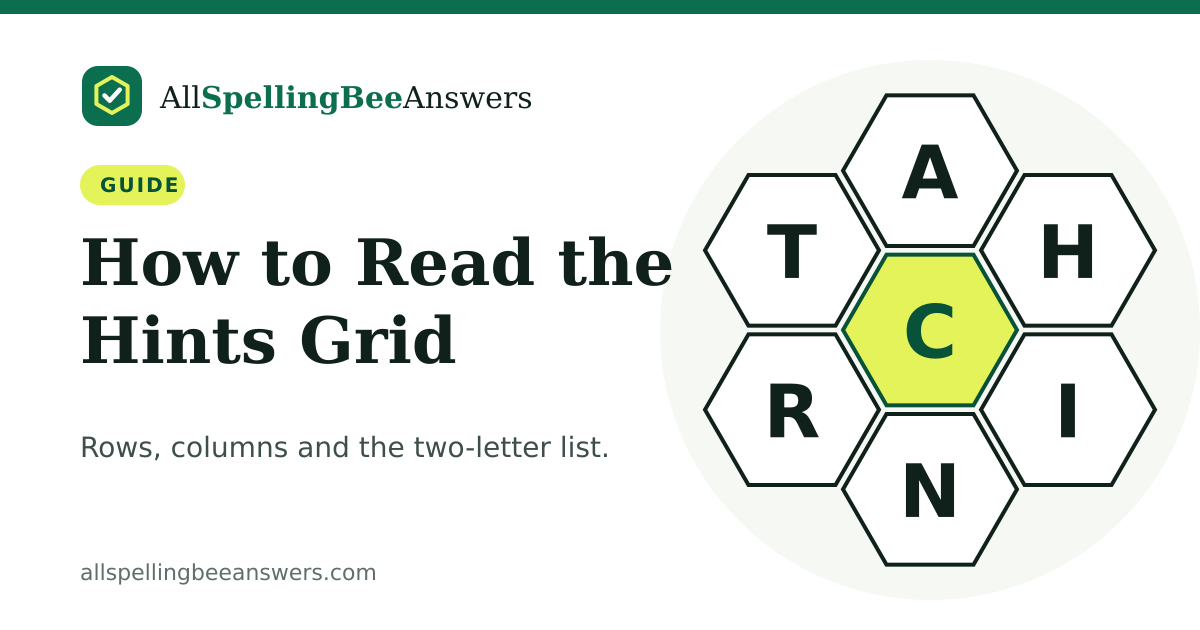
If you have been playing Spelling Bee for a while, you have probably seen two kinds of clues on hint pages: a table full of small numbers, and a list of letter pairs such as TI-3 or CH-2. They look technical at first, but they are the fastest way to find the words you are missing without spoiling the puzzle. This guide explains both, step by step, using an example puzzle.
What the Hints Grid Shows
The hints grid (sometimes called the word grid or letter grid) is a count of every accepted word in the puzzle, arranged by two things at once: the letter each word starts with, and how many letters it has. It never shows the words themselves, which is why it works so well as a spoiler-free hint. You learn where the missing words are, but you still have to find them.
Every hint page on this site uses the same layout, so once you can read one grid you can read them all.
Rows: the first letter
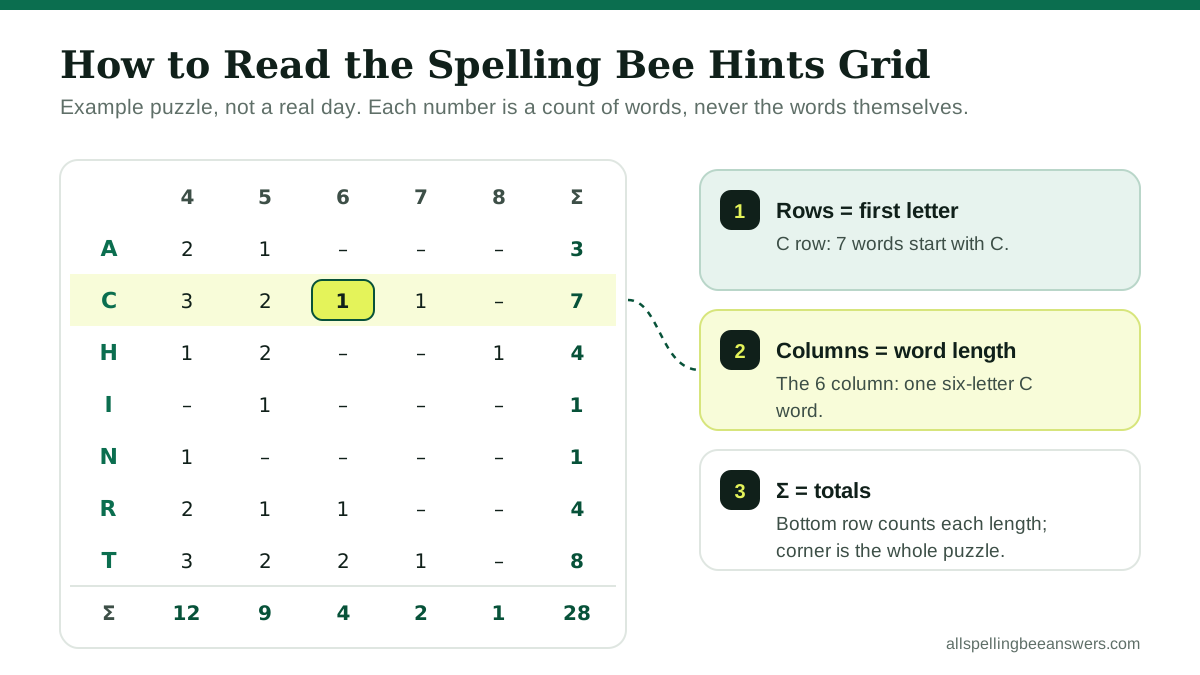
Each row starts with one of the seven puzzle letters. Reading across the row tells you how many words begin with that letter. In the example above, the C row adds up to 7, so seven accepted words start with C. A row that is missing completely means no accepted word starts with that letter. If even one letter has no row, a bingo (at least one word starting with every letter) is not possible that day.
Columns: the word length
The numbers along the top are word lengths. The 4 column counts four-letter words, the 5 column counts five-letter words and so on. In our example, the C row has a 1 under the 6 column, which means there is exactly one six-letter word that starts with C. A dash means there are none.
The Σ (total) row and column
The Σ column on the right is the total for each starting letter. The Σ row along the bottom is the total for each length. The number in the bottom-right corner is the total number of words in the whole puzzle. In the example, there are 28 words, and 12 of them are four letters long.
How to Use the Grid While You Play
The grid is most useful when you compare it with what you have already found. Here is a simple routine:
- Count your own words by row. Take the words you have found and group them by their first letter.
- Find the gaps. Compare your counts with the grid. If the grid says the T row has 8 words and you have found 5, you know three T words are still hidden.
- Narrow it by length. Check which length columns in that row still have words left. "One seven-letter T word" is a much easier target than "some T word".
- Move on when a row is complete. Once your count matches the grid for a letter, stop thinking about that letter. This saves a lot of time.
Doing this by hand works fine, but you can also paste your found words into the word checker on today's answers page. It compares your list with the full answer list and shows only how many words are left in each row and length, without revealing them.
What the Two-Letter List Shows
The two-letter list goes one step further. Instead of grouping words by their first letter, it groups them by their first two letters. An entry such as TI-3 means three accepted words begin with the letters T and I. CH-3 means three words begin with CH.
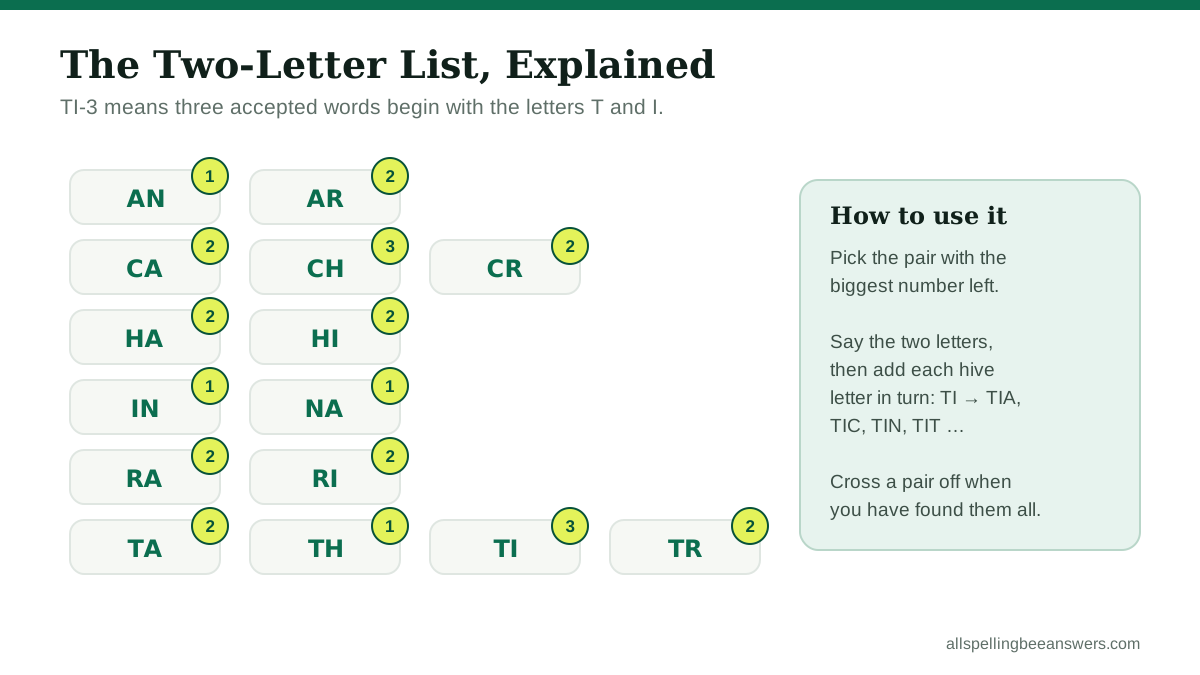
The pairs for one starting letter always add up to that letter's total in the grid. In the example, CA-2, CH-3 and CR-2 add up to 7, which matches the C row. That is a good way to check you are reading both clues correctly.
How to Use the Two-Letter List
The two-letter list is the strongest clue short of the answers, so it is worth using carefully:
- Use it only for rows that still have gaps. If the grid tells you the T row is missing three words, look only at the T pairs.
- Say the pair out loud and add each hive letter. For TI, try TIA, TIC, TIN, TIT and so on. Words often appear as soon as you hear the start.
- Think about common word parts. Pairs such as RE, UN, IN, DE and PR are often the start of a prefix, so try familiar words that begin that way.
- Cross pairs off. When you have found every word for a pair, ignore it from then on.
Grid vs Two-Letter List: Which Should You Use First?
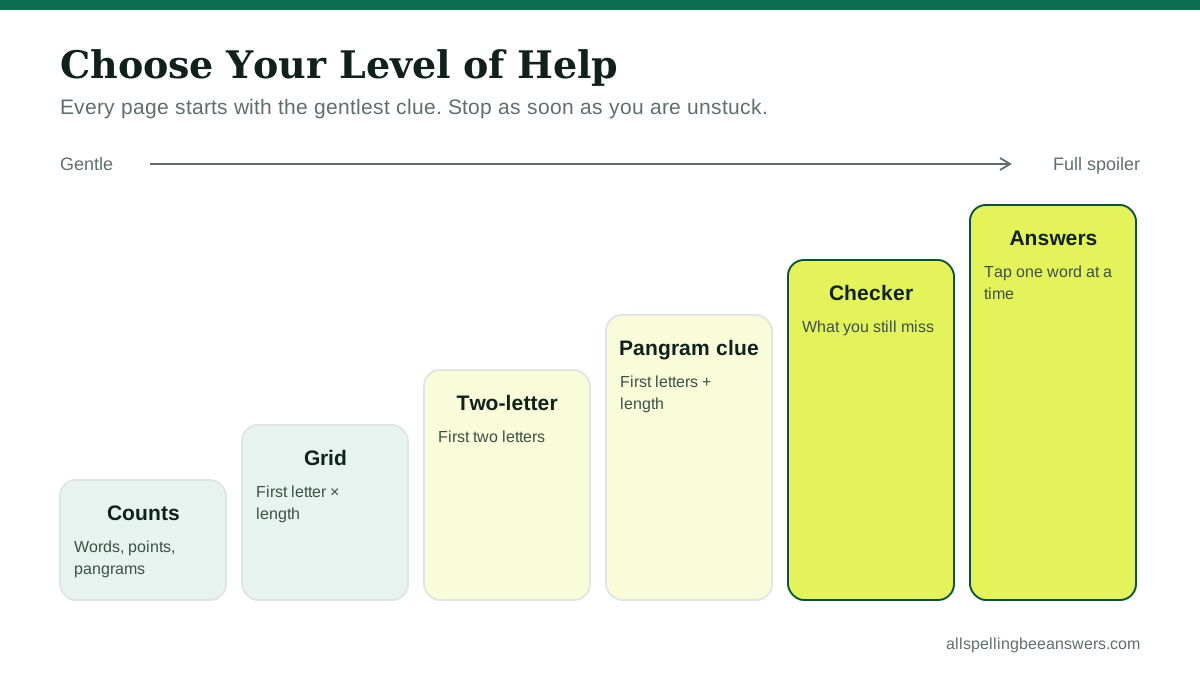
Start with the grid. It tells you which letters and lengths to focus on while leaving most of the work to you. Use the two-letter list when you are stuck on a single row, or when you are a few points away from Genius and want to finish faster. If you want the gentlest possible start, our daily hints page shows clues in order, from word counts to the pangram clue, so you can stop as soon as you are unstuck.
Common Mistakes When Reading the Grid
- Mixing up rows and columns. Rows are letters, columns are lengths. If a number looks too big, check that you are reading across a row, not down a column.
- Forgetting repeated letters. Letters can be used more than once, so a five-letter word can use only three different letters. The grid counts the word's full length.
- Counting words that were not accepted. The puzzle's word list is smaller than a full dictionary. If a word you typed was rejected, it is not part of any count in the grid.
- Assuming every letter has a row. Some letters, especially less common ones, may not start any word.
Frequently Asked Questions
What does Σ mean in the Spelling Bee grid?
Σ is the Greek letter sigma, used here to mean "total". The Σ column is the total for each starting letter and the Σ row is the total for each word length.
What does TI-3 mean in Spelling Bee hints?
It means three accepted words start with the letters T and I.
Is the hints grid a spoiler?
No. It shows counts only, never words. It tells you where to look, but you still need to find each word yourself.
Where can I find today's grid?
On our Spelling Bee hints page, which is updated after each new puzzle is checked.
Ready to try it? Open today's hints, or read our guide on how to find the pangram next.