Guide
How to Play Spelling Bee: Rules, Scoring and Ranks
Everything you need to start playing the daily Spelling Bee, explained in plain English with examples.
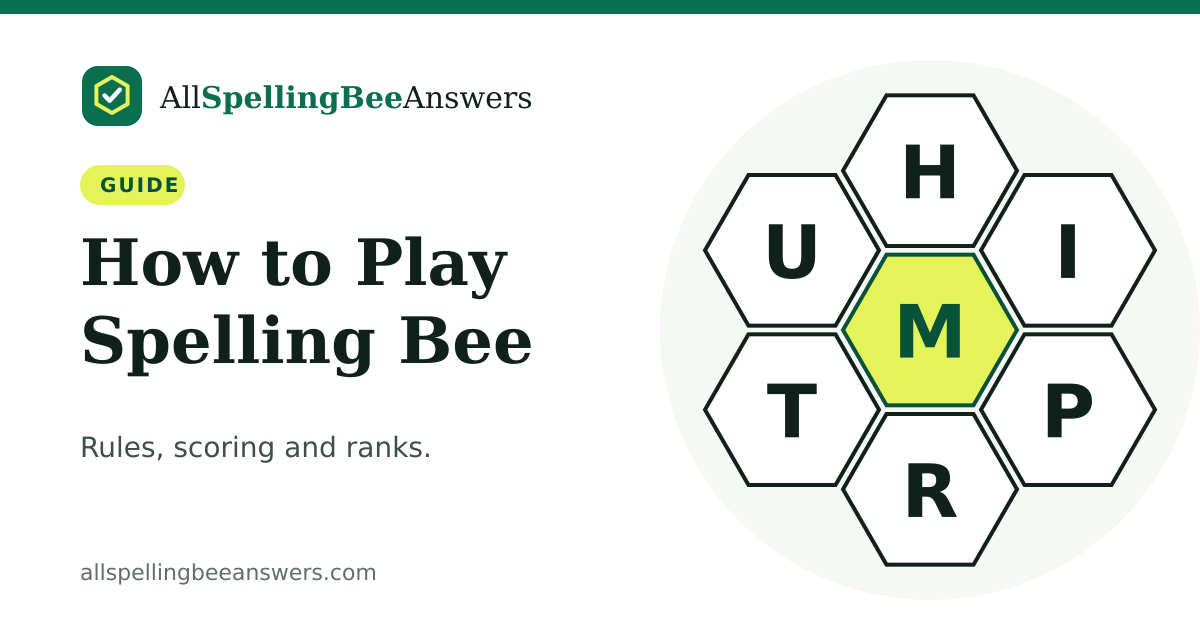
Spelling Bee is a daily word puzzle published by The New York Times. You get seven letters arranged in a honeycomb, and your goal is to make as many words as you can from them. It is simple to learn, but finding every word takes real skill. This guide covers the rules, how scoring works and what each rank means.
The Hive
Each puzzle shows seven different letters in a honeycomb of hexagons. One letter sits in the middle and is highlighted: this is the center letter. The other six letters surround it. A new hive appears every day at 3:00 a.m. Eastern Time.
The Rules
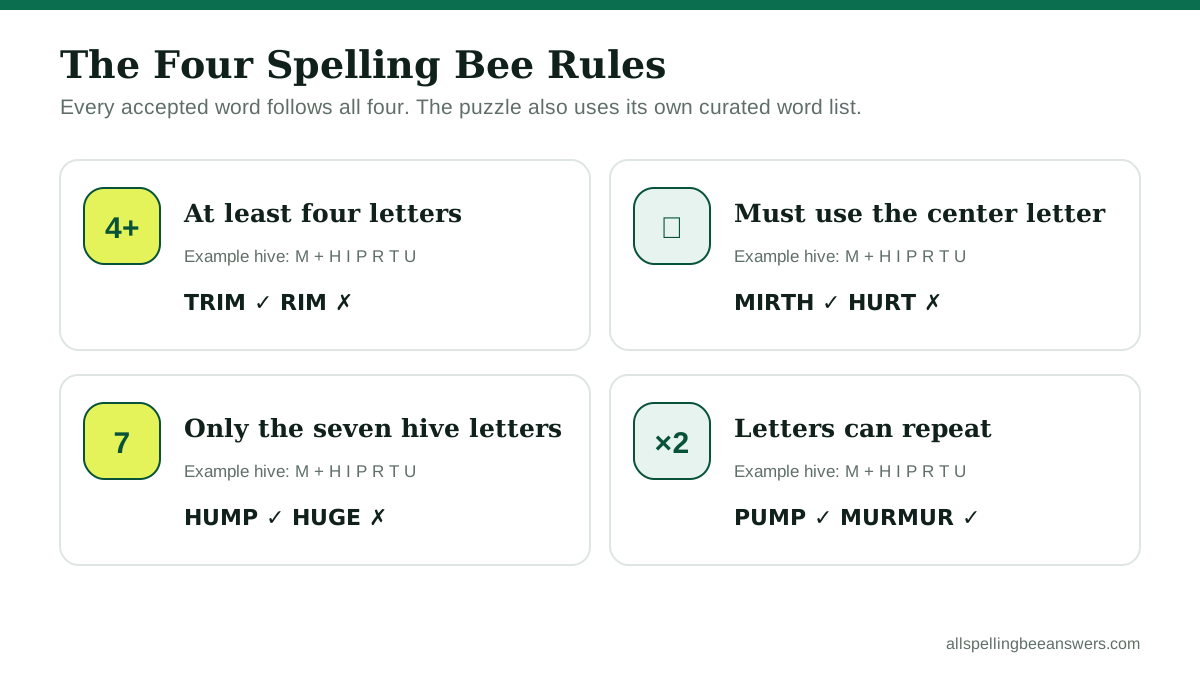
- Words must be at least four letters long. Three-letter words never count.
- Every word must include the center letter. A word made only from the outer six letters is rejected.
- You can only use the seven hive letters. Any other letter makes the word invalid.
- Letters can be used more than once. If the hive has T, you can use it two or three times in one word, as in TOTAL or TATTOO.
The puzzle also uses its own word list. Proper nouns, hyphenated words, very obscure words and words considered offensive are not accepted, even if they appear in a dictionary. The letter S is almost never in the hive, so plurals ending in S are rarely possible.
How Scoring Works
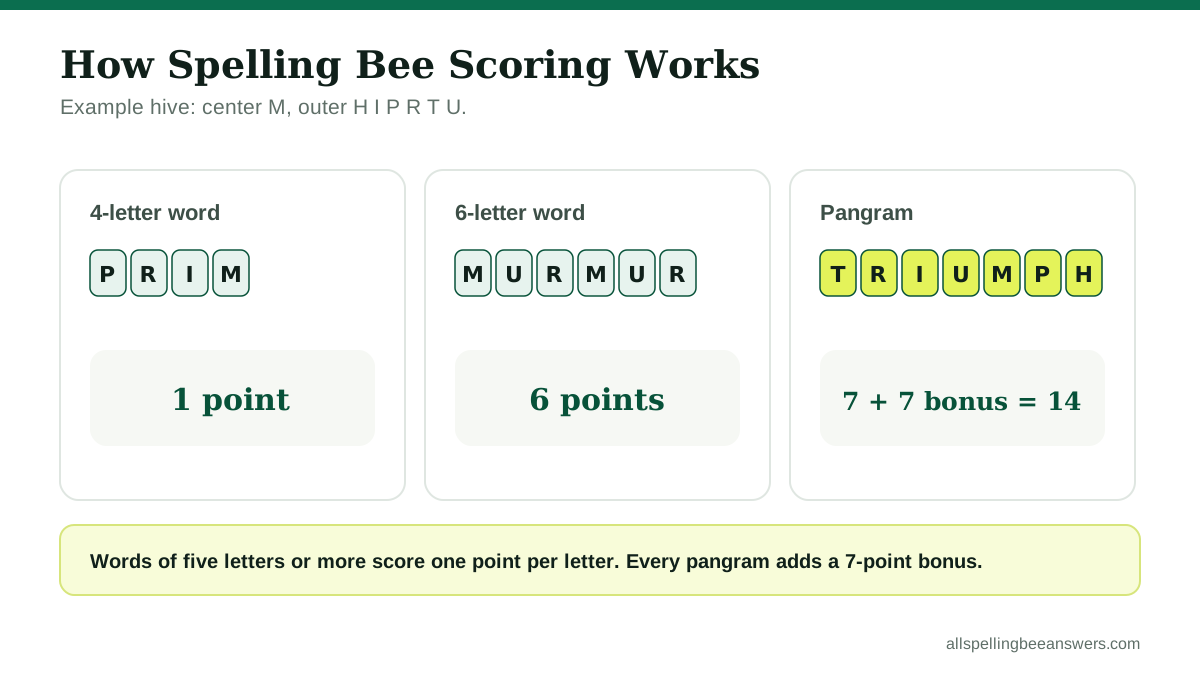
- Four-letter words earn 1 point each.
- Words of five letters or more earn 1 point per letter. A six-letter word earns 6 points.
- Pangrams use all seven letters at least once and earn a 7-point bonus on top of their length. A seven-letter pangram earns 14 points; an eight-letter one earns 15.
Every puzzle has at least one pangram. A perfect pangram uses each letter exactly once, so it is exactly seven letters long. Not every puzzle has one.
The Ranks
As you score, you climb through ten ranks. Each rank is a percentage of the total points available that day, so the numbers change every day.
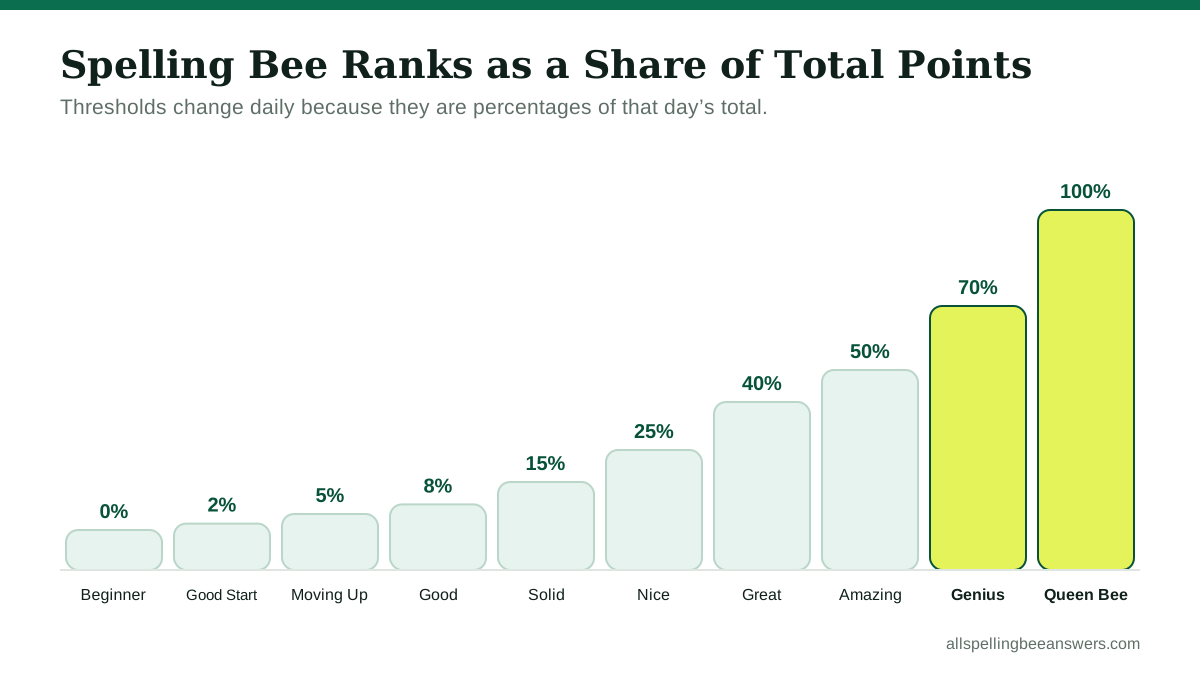
The ranks are Beginner (0%), Good Start (2%), Moving Up (5%), Good (8%), Solid (15%), Nice (25%), Great (40%), Amazing (50%), Genius (70%) and Queen Bee (100%). Queen Bee means you have found every word, and it stays hidden on the rank bar until you reach it. To see the exact points for any puzzle, use our Spelling Bee rank calculator.
Common Terms Players Use
- Pangram: a word that uses all seven letters.
- Perfect pangram: a seven-letter pangram that uses each letter once.
- Genius: the rank at 70% of the total points, the usual daily goal.
- Queen Bee: every accepted word found.
- Bingo: a fan term for a puzzle where every one of the seven letters starts at least one word.
- Hints grid: a table counting words by first letter and length. Our grid guide explains it.
A Short Example
Suppose the center letter is M and the outer letters are H, I, P, R, T and U. TRIM is a valid four-letter word and earns 1 point. HUMP and PRIM earn 1 point each. MIRTH earns 5 points. TRIUMPH uses all seven letters exactly once, so it is a perfect pangram worth 7 + 7 = 14 points. HURT is not allowed because it does not contain M.
Getting Better
- Look for common endings such as -ING, -ED and -ER, especially for the pangram. Our guide on finding the pangram has a four-step method.
- Shuffle the hive often. New positions help you see new letter pairs.
- Try doubling letters and using the center letter twice.
- When you are stuck, use the gentlest help first: our daily hints show counts and grids before anything else.
- To practice with any letters, use our Spelling Bee solver in hints mode.
Frequently Asked Questions
What time does the new Spelling Bee come out?
Every day at 3:00 a.m. Eastern Time.
How many points is a pangram worth?
Its length in points plus a 7-point bonus.
Can you use a letter twice in Spelling Bee?
Yes. Letters can be repeated as often as you like.
Why was my word not accepted?
It may be too short, miss the center letter, use a letter outside the hive, or not be on the puzzle's word list.
Ready to play? Check today's hints or, if you are done, today's answers.